

PSPP Overview
Welcome to the Faculty Physician Scientist Pipeline Program (PSPP). The mission of the Dean’s Faculty Physician Scientist Pipeline Program is to prepare and foster the career development of early-stage physicians and increase the number of highly qualified, competent, and clinically trained scientists who pursue careers focused on translating research evidence into clinical practice and improved patient care. The program will support a cohort of exceptional junior faculty (PSPP scholars) for a period of up to two years (with annual review). Awards (up to $100K in salary support/year) are supported by the SOM Dean’s office to facilitate the development and participation of high-quality research that will lead to enhanced patient care. Areas of special interest include, but are not limited to, cardiometabolic diseases, pulmonary diseases, aging, and cancer across the lifespan in males and females. Selected candidates must commit a minimum of 50% of time/year to research and career development as a PSPP Scholar. For each candidate, the application requires a letter of support from their department chair committing up to $25,000/year to support the PSPP scholar’s annual research-related expenditures, including but not limited to research supplies, staffing, professional meeting expenses, and related travel to present research. Scholars who successfully attain a K award (or equivalent) or R01 (or equivalent) as PI automatically graduate from the program early.
Program Components
Mentored Research: Training Multidisciplinary mentored research training is the backbone of the program and fundamental to successful career development. PSPP Scholars are expected to conduct research, present abstracts at scientific and professional meetings, publish results in high-quality peer-reviewed journals, and submit grant applications to secure extramural support for research (e.g. foundations, K-awards, COBRE pilots/RPL, R awards).
Career Development: Each Scholar’s Career Development Plan will be individualized depending on their research interests, earlier training, education, and goals. All Scholars, in collaboration with their mentor team, will formulate an interdisciplinary research plan addressing appropriate goals, and measures of success.
Didactic Training: Scholars are strongly encouraged to participate in a combination of courses, workshops, and seminars to address specific training goals tailored to their background, experience, career objectives, and interests (e.g., departmental seminars, Career Development (CD) Club, COBRE seminars, school and university-sponsored training such as the Grant Writing Seminars and Workshops).
Key Dates
Our 2025/2026 Faculty Physician Scientist Pipeline (PSPP) Scholars
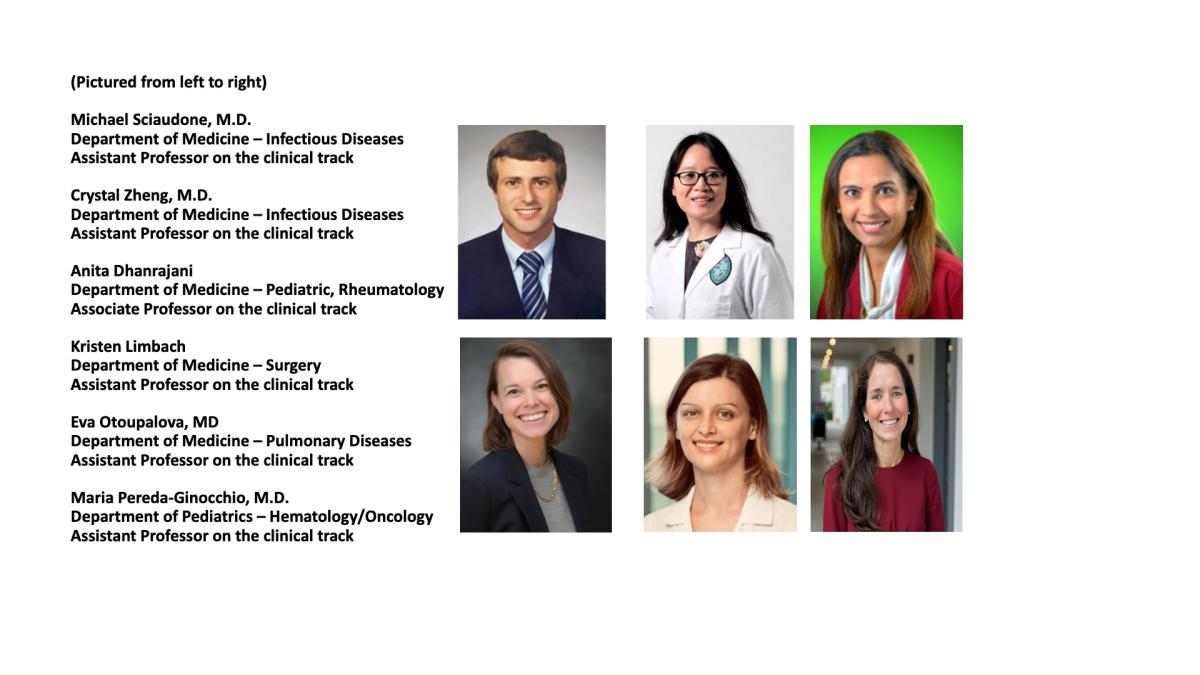
(Pictured from left to right)
Michael Sciaudone, M.D.
Department of Medicine – Infectious Diseases
Assistant Professor on the clinical track
Crystal Zheng, M.D.
Department of Medicine – Infectious Diseases
Assistant Professor on the clinical track
Anita Dhanrajani
Department of Medicine – Pediatric, Rheumatology
Associate Professor on the clinical track
Kristen Limbach
Department of Medicine – Surgery
Assistant Professor on the clinical track
Eva Otoupalova, MD
Department of Medicine – Pulmonary Diseases
Assistant Professor on the clinical track
Maria Pereda-Ginocchio, M.D.
Department of Pediatrics – Hematology/Oncology
Assistant Professor on the clinical track
Resources & Tools for PSPP Scholars
PSPP Toolkit: BOX (click here)
Tulane University School of Medicine, Office of Faculty Affairs, 131 S. Robertson Street, New Orleans, LA 70112
