
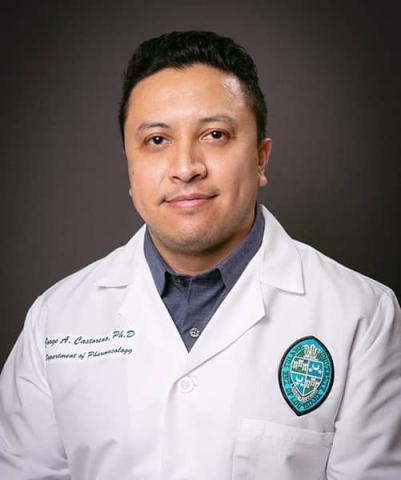
Jorge A. Castorena, PhD
Associate Professor
Biography
Academic Training
- Bachelor of Science in Physics: Universidad de Guanajuato, León, Guanajuato, México (2007)
- Master of Science in Physics: Universidad de Guanajuato, León, Guanajuato, México (2009)
- Doctor of Philosophy in Bioengineering: University of Missouri, Columbia, MO, USA (2014)
- Postdoctoral Fellowship: Laboratory of Dr. Michael J. Davis, University of Missouri, School of Medicine, Columbia, MO, USA (2015-2019).
Faculty Appointments
- Research Assistant Professor (Non-Tenure Track): University of Missouri, School of Medicine, Department of Medical Pharmacology and Physiology, Columbia, MO, USA (2019-2020).
- Assistant Professor (Tenure-Track): Tulane University, School of Medicine, Department of Pharmacology (2020-2026)
- Associate Professor (with Tenure): Tulane University, School of Medicine, Department of Pharmacology (2026-Present)
Areas of Expertise
Research
The lymphatic system comprises the primary mechanism for the return of interstitial fluid from the tissues back to the central veins. The lymphatic networks also serve as the major trafficking system for immune cells, the primary mechanism by which dietary lipids are absorbed, and the primary route for dissemination of cancer metastases.
Deficiency of the lymphatic system can result in abnormal accumulation of fluid, causing lymphedema. Lymphedema can be associated with genetic malformations of the lymphatic vasculature, increased permeability through the lymphatic wall, impaired contractility of lymphatic vessels, and/or incompetent lymphatic intraluminal valves among other.
At present, there are no established cures or treatments for lymphatic diseases, including lymphedema. In the U.S., breast cancer-related lymphedema patients make up the largest group of patients afflicted with this disease and obesity is a known risk factor. Our current research aims to contribute to the understanding of the underlying mechanisms leading to lymphatic system dysfunction and the development of novel therapies for secondary lymphedema patients.
Our lab utilizes a wide range of state-of-the-art techniques including: simultaneous multi-channel confocal microscopy to study intracellular calcium events in the lymphatic vessel wall, pressure myography on isolated lymphatic vessels from animal models and humans, in vivo models of lymphatic dysfunction, including secondary lymphedema associated with injury, primary cell cultures of lymphatic endothelial and muscle cells, and electron microscopy among others. We also devote significant efforts towards developing novel techniques in physiology and software tools for the automated processing and analysis of data and images.
Visit the Castorena Lab Website to learn more!